
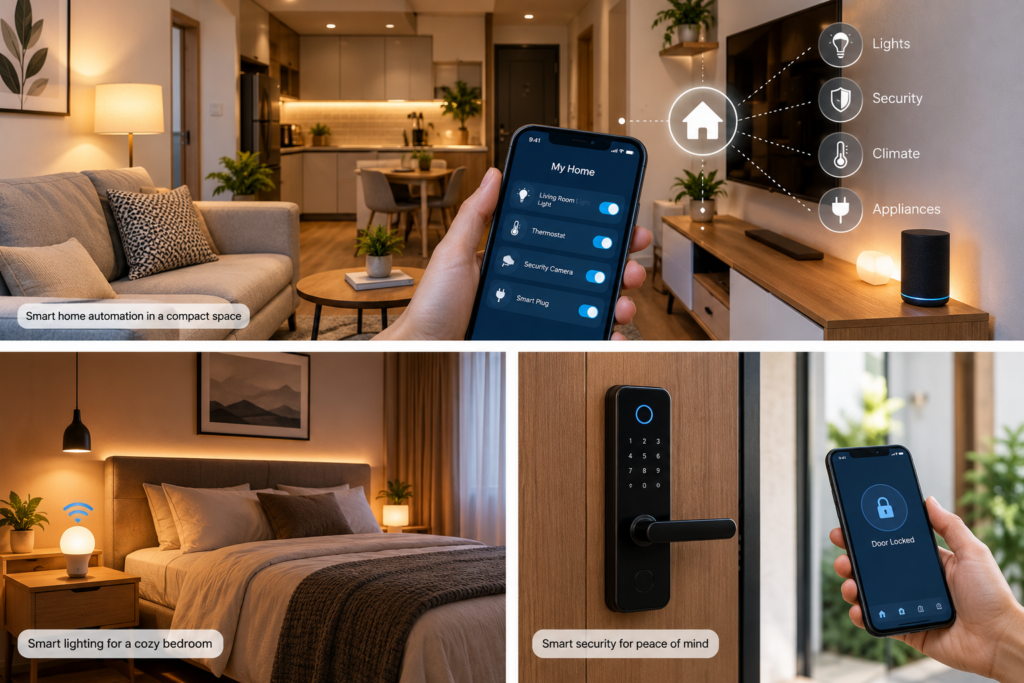
Living in a small home has plenty of advantages. But some time its messy, There the home automation plays a major role.
But small spaces can also become inconvenient quickly
A switch may be hidden behind furniture. Lights may be difficult to control from bed. You may forget to turn off a fan before leaving. Your front door, appliances, and other everyday things may require you to move around the house more than you would like.
This is where home automation can make a real difference.
You do not need to turn your entire house into a futuristic showroom. In fact, a small home is often a great place to start because you can automate the things you use every day without installing a complicated system.
A smart bulb here, a smart plug there, a motion sensor near the entrance, and perhaps a smart security device can make everyday routines easier without taking up much physical space.
In this guide, we will look at some practical home automation ideas for small homes, including affordable options for beginners and simple ways to build a smart home gradually.
What Is Home Automation?
Home automation means using connected devices and technology to control or automate different functions around your home.
Depending on the devices you choose, you might be able to control:
- Lights
- Fans
- Air conditioners
- TVs
- Appliances
- Door locks
- Security cameras
- Sensors
- Plugs
- Curtains
- Heating or cooling systems
Some devices can be controlled from a smartphone, while others can respond automatically to schedules, motion, temperature, or other conditions.
For example, instead of remembering to switch off your living-room light every night, you could schedule it to turn off automatically.
That is a simple example, but it shows the basic idea behind home automation: let technology handle repetitive tasks so you don’t have to think about them constantly.
Why Home Automation Works So Well in Small Homes
You might assume that smart home technology is mainly useful for large houses.
Actually, small homes can benefit significantly from automation.
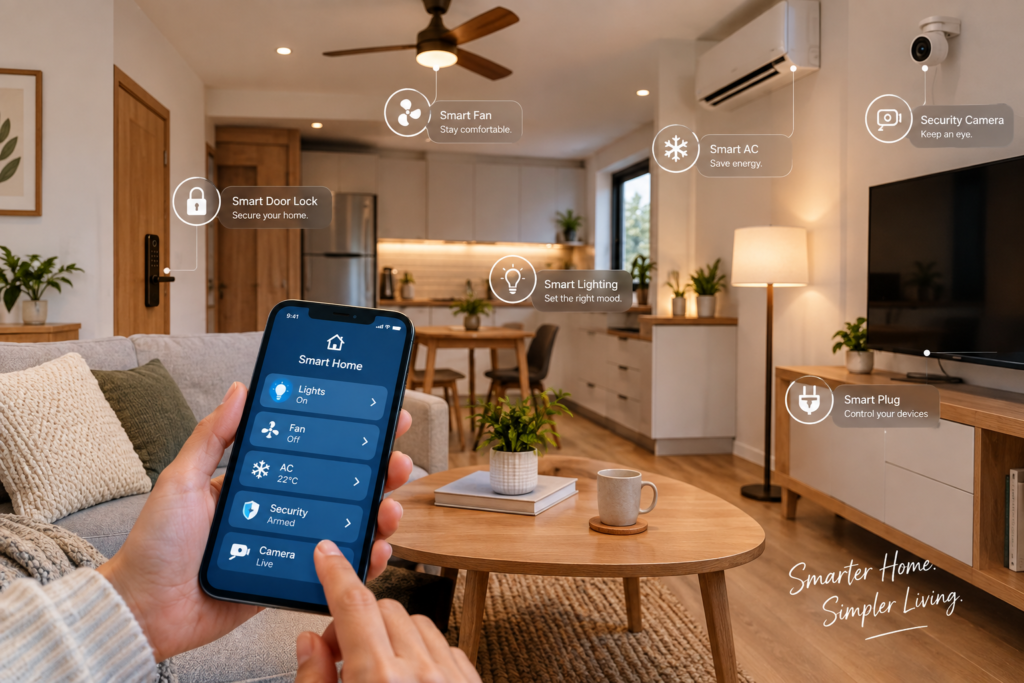
Less clutter
Smart devices can reduce the need for additional switches, remotes, and separate controls.
Easier daily routines
You can control several devices from your phone or through a compatible voice assistant.
Better use of limited space
Compact smart devices can provide useful functions without occupying much room.
Improved energy awareness
Schedules and automated controls can help prevent lights and appliances from being left on unnecessarily.
Added convenience
Small improvements can make everyday routines noticeably easier.
The important thing is to automate useful tasks, not simply automate everything because you can.
10 Home Automation Ideas for Small Homes
1. Start With Smart Lighting
Lighting is probably one of the easiest places to begin.
A smart bulb can allow you to control a light using an app, schedule, or compatible voice assistant.
For a small home, you could start with the lights you use most often.
For example:
- Bedroom light
- Living-room light
- Entrance light
- Desk lamp
- Kitchen light
Imagine getting into bed and realizing you forgot to turn off the living-room light.
Instead of getting up, you can switch it off from your phone if your setup supports remote control.
You can also create schedules.
For example, an entrance light could be programmed to switch on around the time you normally arrive home.
The goal isn’t to make lighting complicated. It is to make it easier to manage.
2. Use Smart Plugs for Existing Appliances
You don’t necessarily need to replace your appliances with expensive smart versions.
A smart plug can sometimes be a simpler starting point.
Depending on the device and smart plug specifications, you may be able to control suitable appliances remotely or schedule when power is supplied.
This can be useful for things such as:
- Lamps
- Fans
- Certain small appliances
- Chargers
- Decorative lights
For example, if you normally switch on a lamp in the evening, a schedule can handle that routine automatically.
However, always check the smart plug’s electrical rating and the appliance manufacturer’s requirements before connecting an appliance. Not every appliance should be controlled through a smart plug.
3. Add Motion Sensors
Motion sensors are particularly useful in smaller homes because they can automate lights without requiring another physical control.
Consider a hallway or entrance.
Instead of searching for a switch when you enter at night, a motion sensor can trigger a compatible light.
They can also be useful in:
- Bathrooms
- Storage areas
- Hallways
- Utility spaces
- Entryways
This type of automation feels natural because you don’t have to actively interact with the system.
You simply enter the space, and the appropriate action happens.
For areas that are used frequently but only for short periods, motion-based lighting can be one of the most practical smart-home upgrades.
4. Make Your Bedroom Smarter with home automation
Your bedroom is another good place to introduce automation.
Think about the small tasks you perform every night.
You might:
- Switch off the main light.
- Turn on a bedside lamp.
- Adjust the fan.
- Charge your phone.
- Set an alarm.
- Check that the door is locked.
Some of these tasks can potentially be integrated into a smart-home routine, depending on the devices you use.
For example, you could create an evening routine that turns off selected lights and activates other compatible devices.
The benefit isn’t really the technology itself.
It is the fact that several small actions can become one simple routine.
5. Consider a Smart Door Lock
Security is another area where automation can be useful.
A compatible smart door lock can offer features such as app-based control, temporary access codes, activity notifications, or automatic locking, depending on the model.
For a small apartment or home, this can be especially convenient.
You don’t necessarily need to carry multiple keys or worry about whether you remembered to lock the door.
However, security devices should be selected carefully. Look at the manufacturer’s security information, installation requirements, battery backup options, and what happens if the device loses power or connectivity.
Smart security should make your home more convenient without creating a new point of failure you haven’t considered.
6. Use a Smart Security Camera
You don’t need several cameras to monitor a small home.
One strategically positioned camera may be enough for your particular needs.
Depending on the model, smart cameras can provide features such as:
- Live viewing
- Motion alerts
- Two-way communication
- Night vision
- Cloud or local recording
Before installing one, think carefully about placement and privacy.
Avoid pointing cameras toward areas where privacy is expected, and understand where recordings are stored and who can access them.
A small home doesn’t require a complicated surveillance system.
The objective should be useful visibility, not unnecessary monitoring.
7. Automate Your Fan or Air Conditioner
Temperature control can become another useful part of a smart home.
If your existing fan, air conditioner, or thermostat supports compatible smart controls, you may be able to integrate it into your automation setup.
For example, you might create a routine that prepares the bedroom before your usual bedtime.
In a small room, temperature can change relatively quickly because there is less air volume.
That makes convenient control particularly useful.
Instead of manually adjusting the device several times a day, you can use schedules or compatible automation features.
Just make sure any smart controller you use is compatible with the specific appliance.
8. Create a “Leaving Home” Routine to make an home automation
This is one of my favorite ideas for beginners because it solves a real everyday problem.
Think about what you normally do before leaving home.
You might:
- Turn off lights
- Switch off selected appliances
- Lock the door
- Turn off the fan
- Check security devices
Instead of doing each action separately, compatible smart devices can potentially be grouped into a single routine.
For example:
Leaving Home
Lights: Off
Selected plugs: Off
Security system: On
Door: Locked
The exact setup depends on your devices and platform, but the principle is simple.
One action can trigger several useful changes.
9. Create a “Good Morning” Routine
Automation isn’t only useful when leaving the house.
You can also create a morning routine.
Imagine waking up and having selected devices respond automatically.
For example:
Bedroom light: Gradually turns on
Curtains: Open
Fan: Adjusts
Kitchen light: Turns on
Not every home needs all of these features.
Even something as simple as scheduling a bedside light can make mornings more convenient.
Start with one task that you perform every morning and see whether automating it genuinely improves your routine.
10. Use Smart Devices to Help Manage Energy
Energy management is another reason people consider home automation.
Lights and appliances that are accidentally left running can add unnecessary consumption.
Automation can help by allowing you to create schedules or remotely check and control compatible devices.
For example, you could schedule certain lights to switch off automatically after a particular time.
You can also use smart plugs or energy-monitoring devices, where supported, to understand how particular appliances are being used.
But it is important to keep expectations realistic.
A smart device does not automatically make an appliance energy-efficient.
The biggest benefit often comes from better control and better habits.
Home Automation on a Budget
You don’t need to spend a huge amount of money to start.
In fact, I would recommend avoiding the temptation to buy ten different smart devices at once.
Start small.
Beginner setup for home automation
You could begin with:
- 1–2 smart bulbs
- One smart plug
- One compatible voice or app-based control system
Once you understand how everything works, you can decide whether additional devices are worthwhile.
Intermediate setup
You might then add:
- Motion sensor
- Smart camera
- Additional smart plugs
- Smart door lock
- Compatible climate control
Advanced setup
Only after understanding your requirements should you consider more complex automation involving multiple rooms and interconnected routines.
The best smart home isn’t necessarily the one with the most devices.
It is the one where each device has a purpose.
How to Choose Smart Home Devices for a Small Space
Before buying anything, ask yourself five questions.
1. Will I actually use it?
If the answer is no, you probably don’t need it.
2. Does it solve a real problem?
Convenience is useful when it addresses something you regularly find annoying.
3. Does it work with my existing devices?
Compatibility matters.
4. Does it need a hub?
Some devices can operate independently, while others may require an additional hub or controller.
5. What happens if the internet goes down?
This is an important question that people sometimes overlook.
A smart device should ideally have a reasonable fallback for essential functions.
Don’t Over-Automate Your Home
There is a point where automation stops being convenient.
Imagine having an extremely complicated system where a simple change requires you to troubleshoot several devices.
That defeats the purpose.
A good automation setup should feel almost invisible.
You shouldn’t constantly think:
“How do I make this work?”
Instead, you should simply notice:
“That’s convenient.”
This is why small homes can benefit from a minimalist approach to smart technology.
Automate the repetitive things.
Keep essential functions simple.
Don’t add technology just because it exists.
Common Home Automation Mistakes
Buying too many devices at once
Start with one or two useful products.
Ignoring compatibility
Always check whether devices can work together before purchasing.
Forgetting about privacy
Understand what information your smart devices collect and where it is stored.
Poor device placement
A sensor or camera is only useful when positioned correctly.
Depending entirely on the internet
Think about what happens if your internet connection fails.
Automating things that aren’t actually inconvenient
Automation should solve problems, not create them.
A Simple Smart Home Plan for a Small House
If you are starting from zero, here’s a straightforward approach.
Week 1: Smart lighting
Start with the room where lighting control would make the biggest difference.
Week 2: Smart plug
Choose one suitable appliance or lamp that you regularly forget to control.
Week 3: Motion sensor
Try one in a suitable hallway, entrance, or utility area.
Week 4: Build a routine
Connect compatible devices into a simple “Good Night” or “Leaving Home” routine.
After a month, you will have a much better understanding of which automation features you actually enjoy using.
From there, expand only when you have a genuine reason.
Frequently Asked Questions
Is home automation worth it for a small home?
Yes, it can be. A small home doesn’t require dozens of smart devices. A few carefully chosen products can improve lighting, security, convenience, and everyday routines.
What is the easiest home automation to start with?
Smart lighting is usually a straightforward starting point because you can begin with a single compatible bulb or lamp and expand later.
Can I automate my home without replacing my appliances?
In many cases, yes. Depending on the appliance and its electrical requirements, compatible smart plugs or controllers may allow certain existing devices to be incorporated into an automation setup. Always check compatibility and safety requirements first.
Is home automation expensive?
It doesn’t have to be. You can start with one or two affordable devices and expand gradually instead of buying a complete system at once.
Is smart home technology safe?
It can be, but security and privacy depend on the devices, software, configuration, and manufacturer. Use strong unique passwords, keep firmware updated, enable available security features, and understand how your devices handle data.
Does home automation save electricity?
Automation can help reduce unnecessary usage by scheduling or switching off compatible devices, but the actual savings depend on your appliances, usage habits, schedules, and the automation system.
Final Thoughts
The best home automation ideas for small homes are not necessarily the most advanced ones.
They are the ideas that make everyday life a little easier.
A light that turns on when you arrive home.
A plug that switches off at a scheduled time.
A motion sensor that handles the hallway light.
A door lock that lets you check your home remotely.
A simple routine that prepares your home when you wake up or leave for work.
None of these things is revolutionary by itself.
Together, however, they can make a small home feel more convenient, organized, and responsive.
And that’s probably the best way to approach smart-home technology: start with a problem, find a simple solution, and expand only when you need to.
You don’t need a futuristic house.
You just need a home that works a little better for you.